

Demonstration Plant
Austpac’s technologies, collectively termed the “ERMS SR” process, were proven at a newly constructed 3,000 tpa Demonstration Plant during 2008. The showcasing of the relevant technologies at the Plant, including ilmenite roasting, synthetic rutile production, EARS acid regeneration, the continuous leach reactor (CLR) and the direct reduction of iron oxides to iron pellets (Austpac Iron), was a major achievement that has allowed the Company to move into commercialisation. Austpac has now proved the world’s only fully continuous synrutile process that produces ultra-high grade synthetic rutile and an iron co-product. Operations at the plant also proved the ability of the EARS to regenerate acid from spent pickle liquor (a waste created in finishing some steel products), and of the DRI process to produce iron metal pellets from iron ore fines, thus widening the commercial applications for the Company’s technologies. The 3,000 tpa Demonstration Plant has proven the technologies under continuous commercial conditions.
 The Kooragang Island Plant in 2000
Kooragang Island Plant 1998
In early 1998, Austpac adapted a decommissioned hydrofluoric acid plant on Kooragang Island in Newcastle NSW to serve as the site of the Company’s 3,000 tonnes per annum ERMS SR Synthetic Rutile Demonstration Plant. The removal of a variety of old equipment from the site provided an open six storey framework to begin the construction of pilot plant facilities for the development of the Company’s technologies.
In 2000, three roasters were installed in the plant. They could be operated individually or in a series, using solid, liquid or gaseous fuels, which provided more flexibility to the roasting operations.
The Kooragang Island pilot plant was run in various configurations on a campaign basis for internal test work and research as well as client based applications, commencing in 2000.
By 2004, Austpac recognised it would be necessary to build a more sophisticated plant capable of testing all the technologies that comprise the ERMS SR process. Such a plant was necessary to prove the technologies at a sufficient scale prior to committing to a commercial development, and funds were sought for a Demonstration Plant capable of producing synthetic rutile at a rate of 3,000 tpa.
In 2006 BHP Billiton recognised the potential of the ERMS SR technology by funding a successful research program. In 2007 and 2008, BHP Billiton supported Austpac’s capital raisings to fund the construction and operation of the ERMS contributing a total of $8 million (AUD) in two share placements to become at that time Austpac’s largest shareholder. BHP Billiton remains the Company’s third largest shareholder (4.18%).
In July 2007, Austpac commenced construction of the 3,000 tpa ERMS SR plant to demonstrate the Company’s synthetic rutile, acid regeneration and iron reduction processes. The Demonstration Plant was constructed and operated in two stages, as outlined below.
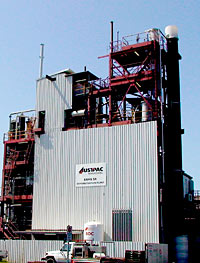 ERMS SR Demonstration Plant – 2008
ERMS SR – Stage One
Stage 2 comprised the ilmenite leaching and EARS acid regeneration section of the plant. Roasted ilmenite and hydrochloric acid (HCl) were mixed and pumped into Austpac’s patented continuous leach vessel, where the iron was leached from the ilmenite leaving a high TiO2 solid. The solid synthetic rutile was separated from the iron chloride solutions on a filter, then dried, heated (calcined) and finally passed over a magnetic separator to remove any remaining waste minerals.
Stage 1 roasting operations were undertaken on a continuous basis and completed during the first half of 2008, during which time 720 tonnes of ilmenite concentrate were roasted. Throughout the campaign, samples of the bulk-roasted ilmenite were bench-scale leached and the resultant synrutile was consistently an ultra-high grade product (97% TiO2) with very low contaminants.
 Continuous Leach Reactor –
Demonstration Plant (2008)
ERMS SR – Stage Two
Stage two comprised the ilmenite leaching and EARS acid regeneration section of the plant. Roasted ilmenite and hydrochloric acid (HCl) were mixed and pumped into Austpac’s patented continuous leach vessel, where the iron was leached from the ilmenite leaving a high TiO2 solid. The solid synthetic rutile was separated from the iron chloride solutions on a filter, then dried, heated (calcined) and finally passed over a magnetic separator to remove any remaining waste minerals.
The iron chloride rich “spent leach liquor” was pumped to the adjacent EARS acid regeneration plant, where it was dried in a fluid bed evaporator to form a solid iron chloride pellet. The pellets were then heated in the fluid bed pyrohydrolysis reactor to form hydrogen chloride gas and iron oxide pellets. The gas was absorbed in water, forming strong HCl which was returned to the leaching section. The iron oxide was then passed to Austpac’s proprietary fluid bed “metalliser” where it was reduced to iron metal (DRI).
Commissioning of the synthetic rutile and iron production section commenced in July 2008. In September 2008, iron ore fines from Pilbara region of WA were used to commission the fluid bed metallising section, and to successfully produce an iron product. It is highly significant that Austpac’s Iron Reduction process was demonstrated as applicable for value-adding to iron ore.
Spent pickle liquor from a steel mill was used to commission the EARS acid regeneration section of the plant, which demonstrated that the EARS system could recycle steel mill waste liquors.
A tank farm was installed to store spent leach liquor, pickle liquor, regenerated hydrochloric acid, process water for recycling, and to capture storm water run-off, both saving water and ensuring that the plant produces no liquid effluents.
A carbon dioxide (CO2) absorption system is integral to the EARS/Iron Reduction process which removes over half of the CO2 from the exit roaster gases. In a commercial plant the CO2 could be stored for sale to other industries, thus creating revenue whilst demonstrating environmental responsibility.
By October 2008, Stage Two of the Plant was operational, and the previously roasted ilmenite from the Murray Basin was leached in Austpac’s patented Continuous Leach Reactor (CLR). The leached ilmenite was dried, calcined and any remaining magnetic particles were removed to ensure purity of the bulk synrutile. Analyses of the bulk sample confirmed that the synrutile contained over 97% TiO2, proving the leaching efficiency of the CLR equipment. The bulk synrutile also contained very low levels of iron and other impurities, and negligible amounts uranium and thorium, confirming it is suitable for titanium metal manufacture.
The ERMS SR process, including ilmenite roasting, the continuous leach reactor, and the EARS acid regeneration/Iron Reduction steps, was proven during Plant operations in the fourth quarter of 2008. Austpac has the world’s only fully continuous synrutile process that produces ultra-high grade synthetic rutile and an iron co-product. Operations at the Plant also proved the ability of the EARS process to regenerate acid from spent pickle liquor, and of the iron reduction process to produce iron metal pellets from iron ore fines, thus widening the commercial applications for the Company’s technologies.
As described elsewhere, in 2009 work began on transforming the EARS/Iron Reduction section of the Plant into a commercial steel mill waste recycling facility; the Newcastle Iron Recovery Plant. This will become operational in 2015
Data from the 2008 operations at the ERMS SR Demonstration Plant and the upcoming operations of the Newcastle Iron Recovery Plant will in the future be used for detailed engineering design and a bankable feasibility study into a future commercial ERMS SR synthetic rutile plant.
Return to top